The air route between Santiago and Mendoza is the most turbulent in the world according to Turbli, a turbulence forecasting site that analyzed some 10,000 routes between 550 airports: it scored an average index of 22.983 out of 100. Three of the five bumpiest routes on the planet start or end in Santiago: also Córdoba-Santiago (fourth, 18.643) and Santa Cruz de la Sierra-Santiago (fifth, 18.330), according to Turbli's 2025 table as reproduced by Your Mileage May Vary.
*Updated November 4, 2026.* Note the date: the ranking covers 2025 data and Turbli published it in January 2026. It went viral again this week in Chile and Argentina, in ADN Radio and Tiempo de San Juan among others, following a report by Emol. It is the second year in a row that Mendoza-Santiago comes first.
The world's most turbulent routes and the Santiago-Mendoza flight
| Rank | Route | Distance | Average EDR index |
|---|---|---|---|
| 1 | Mendoza (MDZ) - Santiago (SCL) | 196 km | 22.983 |
| 2 | Xining (XNN) - Yinchuan (INC), China | 433 km | 18.935 |
| 3 | Chengdu (TFU) - Xining (XNN), China | 724 km | 18.758 |
| 4 | Córdoba (COR) - Santiago (SCL) | 660 km | 18.643 |
| 5 | Santa Cruz de la Sierra (VVI) - Santiago (SCL) | 1,905 km | 18.330 |
| 6 | Chengdu (TFU) - Lanzhou (LHW), China | 692 km | 18.322 |
| 7 | Mendoza (MDZ) - Salta (SLA), Argentina | 940 km | 18.307 |
| 8 | Chengdu (CTU) - Yinchuan (INC), China | 890 km | 18.282 |
| 9 | Xining (XNN) - Lhasa (LXA), China | 1,312 km | 18.181 |
| 10 | Denver (DEN) - Jackson (JAC), United States | 653 km | 18.180 |
Source: Turbli, "Most turbulent flight routes of 2025," per the table reproduced by Your Mileage May Vary (March 2026). Turbli uses forecast data from the US NOAA and the UK Met Office.
What the turbulence index measures
Turbli measures turbulence with the eddy dissipation rate (EDR), the indicator aviation uses for the intensity of air movement. Its scale runs from 0 to 100. An average of 22.983 means that on a typical flight on that route the forecast turbulence falls in the moderate range.
| EDR index (Turbli) | Turbulence |
|---|---|
| 0 to 20 | Light |
| 20 to 40 | Moderate |
| 40 to 60 | Moderate to severe |
| 60 to 80 | Severe |
| 80 to 100 | Extreme |
Turbli is a turbulence forecasting site created by Ignacio Gallego-Marcos, an engineer specialized in fluid dynamics. Each year it publishes the ranking with the previous year's data for some 10,000 popular routes between 550 of the world's largest airports. In the 2025 edition, five of the ten most turbulent routes are in China, on and around the Tibetan plateau, and four touch South America, all crossing or skirting the Andes.
It is an annual average: there are calm days and very bumpy ones. And it is a statistical forecast of air conditions, not a record of incidents.
Why the Santiago-Mendoza flight is so bumpy
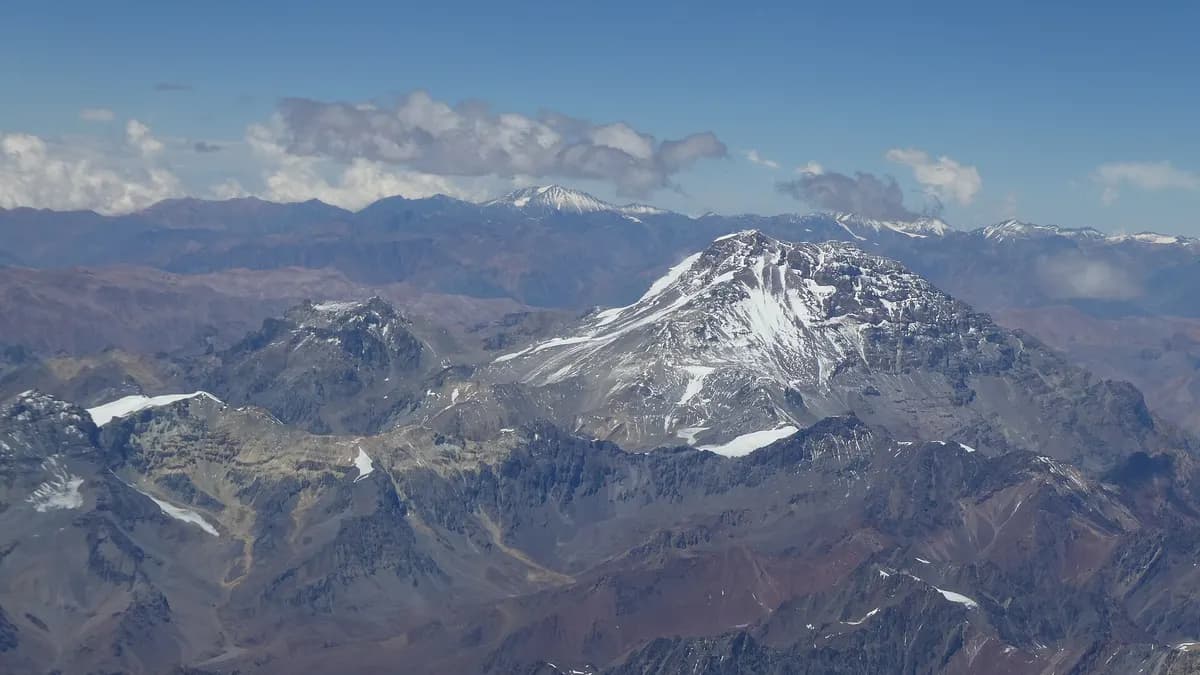
The explanation is the Andes. Winds coming from the Pacific hit a wall more than 6,000 meters high (Aconcagua is 6,961 m) and the air rises and falls sharply, creating so-called mountain waves. Add strong winds aloft and rapid changes in temperature and pressure. On a flight of about 45 minutes to an hour, much of the trip is spent climbing or descending over that zone, according to Tiempo de San Juan and ADN Radio.
In the South American ranking cited by ADN, Santiago appears in six of the ten most turbulent routes, including Bariloche-Santiago (ninth) and Asunción-Santiago (tenth). A year earlier, with 2024 data, Mendoza-Santiago scored 24.684 and Córdoba-Santiago 20.214, according to Reader's Digest: both routes lowered their index in 2025 but stayed at the top.
| Route | 2024 data | 2025 data | 2025 rank |
|---|---|---|---|
| Mendoza-Santiago | 24.684 | 22.983 | 1 |
| Córdoba-Santiago | 20.214 | 18.643 | 4 |
| Santa Cruz-Santiago | 18.598 | 18.330 | 5 |
| Bariloche-Santiago | 18.475 | Outside the world top 10 | 9 in South America |
What to do if you fly between Santiago and Mendoza
- Keep your seat belt fastened the whole flight, even when the sign is off: most turbulence injuries happen to passengers without a belt.
- Stow your carry-on properly and be careful with hot drinks during climb and descent.
- If you get airsick, choose a seat over the wings, where movement is felt less, and look at the horizon.
- The overland alternative is the Cristo Redentor pass, about 6 to 7 hours by bus, subject to snow closures; check its status this week.
Specialists quoted in the press note that crews treat these mountain turbulences as routine and that commercial aircraft are designed to withstand them. On what happens when lightning hits a plane, another scary but rarely serious event, we wrote this story. To see which routes carry the most passengers from Chile, check the ranking of Chile's busiest air routes.
Frequently asked questions
Is it dangerous to fly from Santiago to Mendoza?
The average index is in the moderate turbulence range. It is uncomfortable, but crews expect it and handle it; the most important thing for passengers is to keep their seat belt fastened.
Is Turbli's ranking new?
It covers 2025 data and was published in January 2026. It made headlines again in November 2026. Turbli publishes one edition per year.
How long is the Santiago-Mendoza flight?
Between 45 minutes and an hour, for 196 kilometers in a straight line.