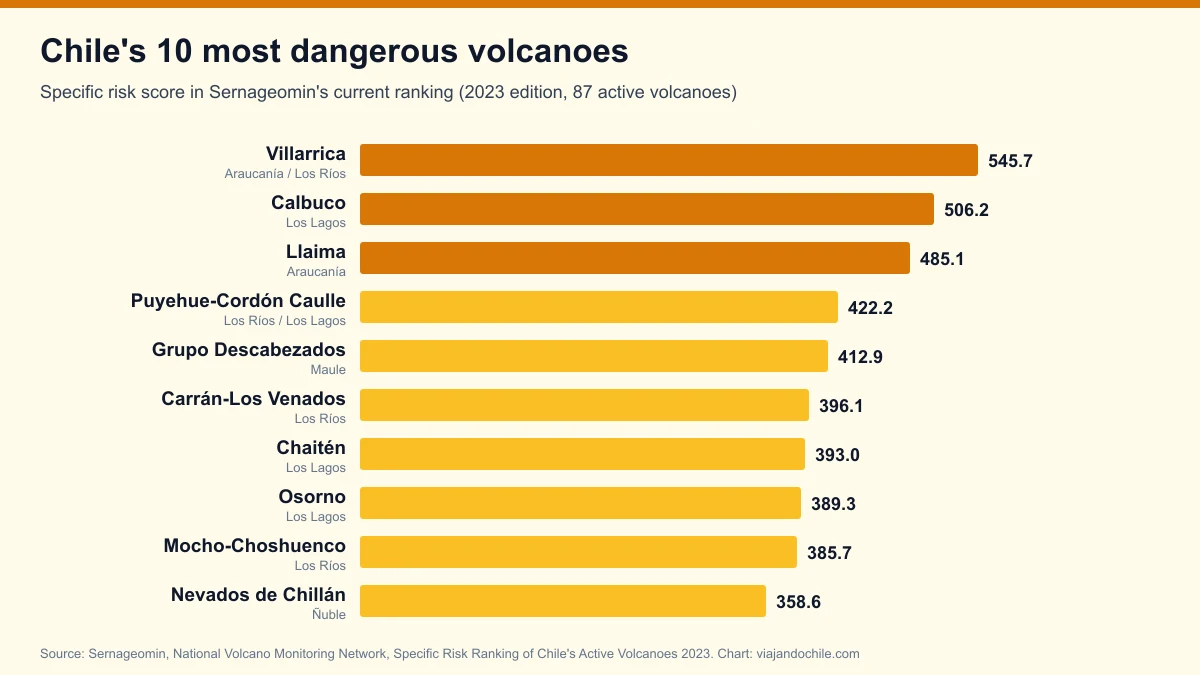
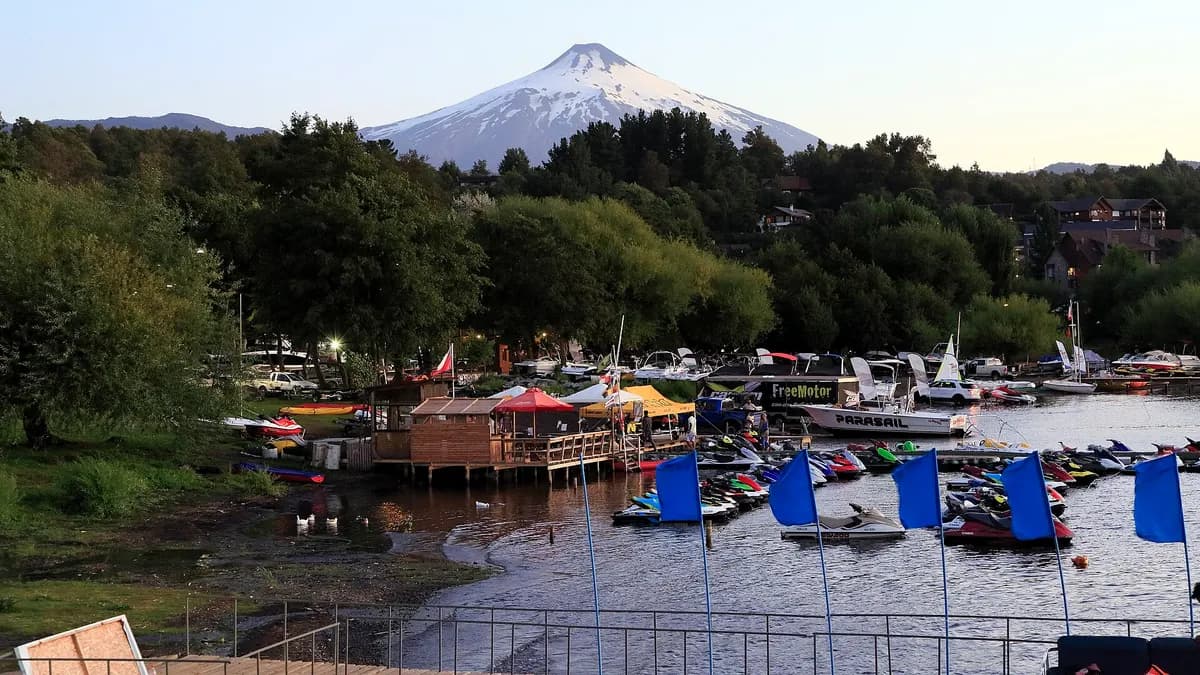
Chile's most dangerous volcano is Villarrica, with a specific risk score of 545.7, followed by Calbuco (506.2) and Llaima (485.1). This is set out in the Specific Risk Ranking of Chile's Active Volcanoes by the National Geology and Mining Service (Sernageomin), which ranks the country's 87 active volcanic systems by their hazard and the population and infrastructure exposed. The current edition is from 2023, and Sernageomin still cites it as the official ranking on its volcanic alerts page.
*Updated on October 20, 2026.* This list will be updated on this same page when Sernageomin publishes a new edition of the ranking.
The 20 most dangerous volcanoes in Chile
| # | Volcano | Region | Hazard | Exposure | Specific risk |
|---|---|---|---|---|---|
| 1 | Villarrica | La Araucanía and Los Ríos | 23.0 | 23.7 | 545.7 |
| 2 | Calbuco | Los Lagos | 23.0 | 22.0 | 506.2 |
| 3 | Llaima | La Araucanía | 22.5 | 21.6 | 485.1 |
| 4 | Puyehue-Cordón Caulle | Los Ríos and Los Lagos | 21.0 | 20.1 | 422.2 |
| 5 | Grupo Descabezados | Maule | 21.5 | 19.2 | 412.9 |
| 6 | Carrán-Los Venados | Los Ríos | 18.5 | 21.4 | 396.1 |
| 7 | Chaitén | Los Lagos | 19.5 | 20.2 | 393.0 |
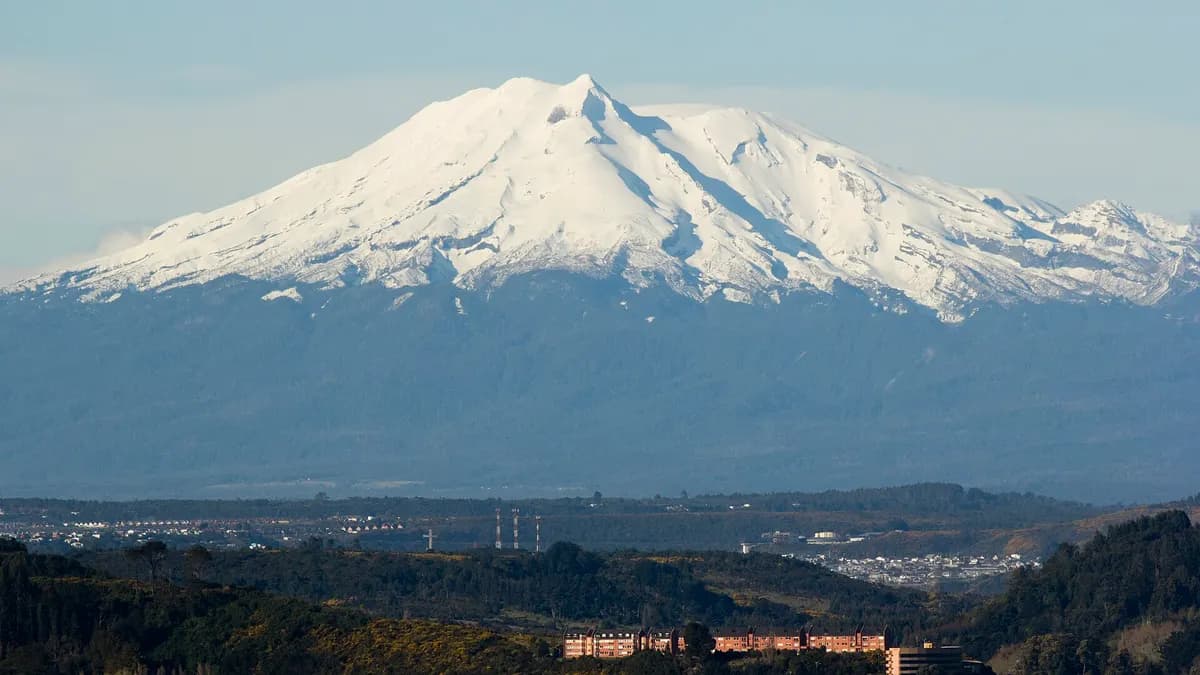
| 8 | Osorno | Los Lagos | 20.5 | 19.0 | 389.3 |
| 9 | Mocho-Choshuenco | Los Ríos | 19.0 | 20.3 | 385.7 |
| 10 | Nevados de Chillán | Ñuble | 20.0 | 17.9 | 358.6 |
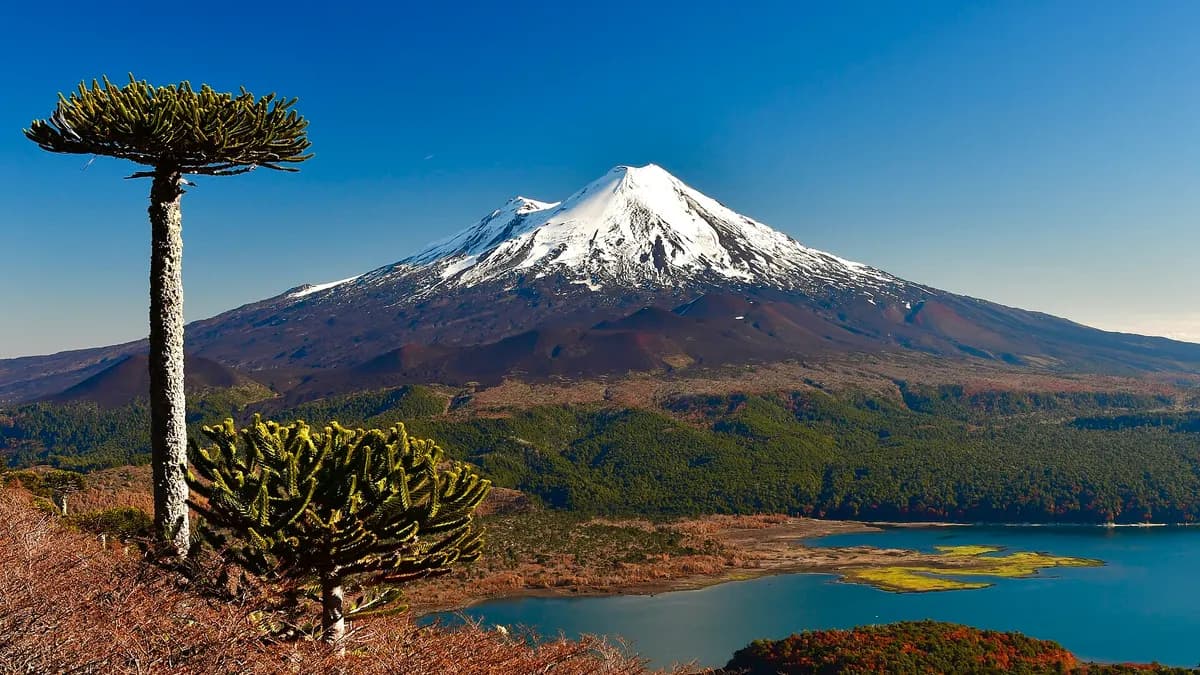
| 11 | Lonquimay | La Araucanía | 17.5 | 19.5 | 342.0 |
| 12 | Hudson | Aysén | 20.5 | 16.3 | 333.7 |
| 13 | Antuco | Biobío | 19.0 | 16.2 | 307.7 |
| 14 | Láscar | Antofagasta | 17.0 | 14.7 | 249.7* |
| 15 | Copahue | Biobío | 17.0 | 16.5 | 281.1 |
| 16 | Antillanca | Los Lagos | 16.0 | 17.5 | 280.3 |
| 17 | Parinacota | Arica y Parinacota | 18.0 | 15.4 | 276.8 |
| 18 | Callaqui | Biobío | 15.0 | 17.6 | 264.1 |
| 19 | Michinmahuida | Los Lagos | 14.5 | 17.8 | 258.4 |
| 20 | Yate | Los Lagos | 13.0 | 19.9 | 258.1 |
Source: Sernageomin, National Volcano Monitoring Network, Specific Risk Ranking of Chile's Active Volcanoes 2023. *Láscar is in 14th place due to “criteria complementary to the score”, according to the document itself. The top 14 make up the “very high specific risk” category.
Specific risk combines two groups of factors: hazard factors, which measure how and how much the volcano has erupted, and exposure factors, which measure what is around it (population, roads, services). That is why a very active but isolated volcano, like Láscar on the Altiplano, can rank below others with less activity but with towns nearby.
Most dangerous volcanoes in Chile by risk category
| Category | Positions | Volcanoes | Sernageomin description |
|---|---|---|---|
| 1 | 1 to 14 | 14 | Very high specific risk |
| 2 | 15 to 31 | 17 | High specific risk |
| 3 | 32 to 54 | 23 | Moderate specific risk |
| 4 | 55 to 71 | 17 | Low specific risk |
| 5 | 72 to 87 | 16 | Very low specific risk |
Source: Sernageomin, 2023 ranking. Count by category: Viajando Chile. Most volcanoes in categories 1 and 2 lie between Maule and Los Lagos, the area with the most people living near the Andes. The north has high, active volcanoes such as Láscar or Ojos del Salado, the world's highest volcano, but few people around them.
Current volcanic alerts in 2026
Ranking high does not mean a volcano is about to erupt. Its daily status is reported by Sernageomin through a technical alert traffic-light system. According to its alerts page, in October 2026 two top-10 volcanoes are on yellow technical alert:
| Volcano | Ranking position | Technical alert | Nearby tourist area |
|---|---|---|---|
| Villarrica | 1 | Yellow | Pucón, Villarrica, Coñaripe |
| Nevados de Chillán | 10 | Yellow | Las Trancas, Termas de Chillán |
Source: Sernageomin, volcanic alerts, checked on October 20, 2026. For Nevados de Chillán, Sernageomin notes that the active sub-complex, Las Termas, is close to Las Trancas, “where there is significant tourism linked to ski resorts, hot springs and hiking”. Details for travelers in our story on the Nevados de Chillán yellow alert.
Visiting volcanoes in Chile safely
- Check the alert of the day: Sernageomin publishes special reports when a volcano's activity changes, and Conaf may close trails.
- Guided climbs: climbing Villarrica requires a guide and suitable conditions; see how to climb Villarrica volcano.
- National parks: Llaima, third in the ranking, is in Conguillío National Park, and Osorno, eighth, in Vicente Pérez Rosales National Park.
- Skiing on volcanoes: resorts such as Corralco, on Lonquimay, or Antillanca, on the volcano of the same name, operate on active volcanoes in the ranking.
How to cite this data
Viajando Chile (2026). *The most dangerous volcanoes in Chile in 2026: the Sernageomin ranking*. With data from the Specific Risk Ranking of Chile's Active Volcanoes 2023 (Sernageomin). https://viajandochile.com/en/news/most-dangerous-volcanoes-in-chile-sernageomin-ranking
Frequently asked questions
What is the most dangerous volcano in Chile?
Villarrica, in La Araucanía and Los Ríos, first in Sernageomin's specific risk ranking with 545.7 points.
How many active volcanoes does Chile have?
87 geologically active volcanic systems, according to the 2023 edition of Sernageomin's ranking. The 2019 edition counted 92.
Which volcanoes are on alert in 2026?
As of October 20, 2026, Villarrica and Nevados de Chillán are on yellow technical alert, according to Sernageomin.