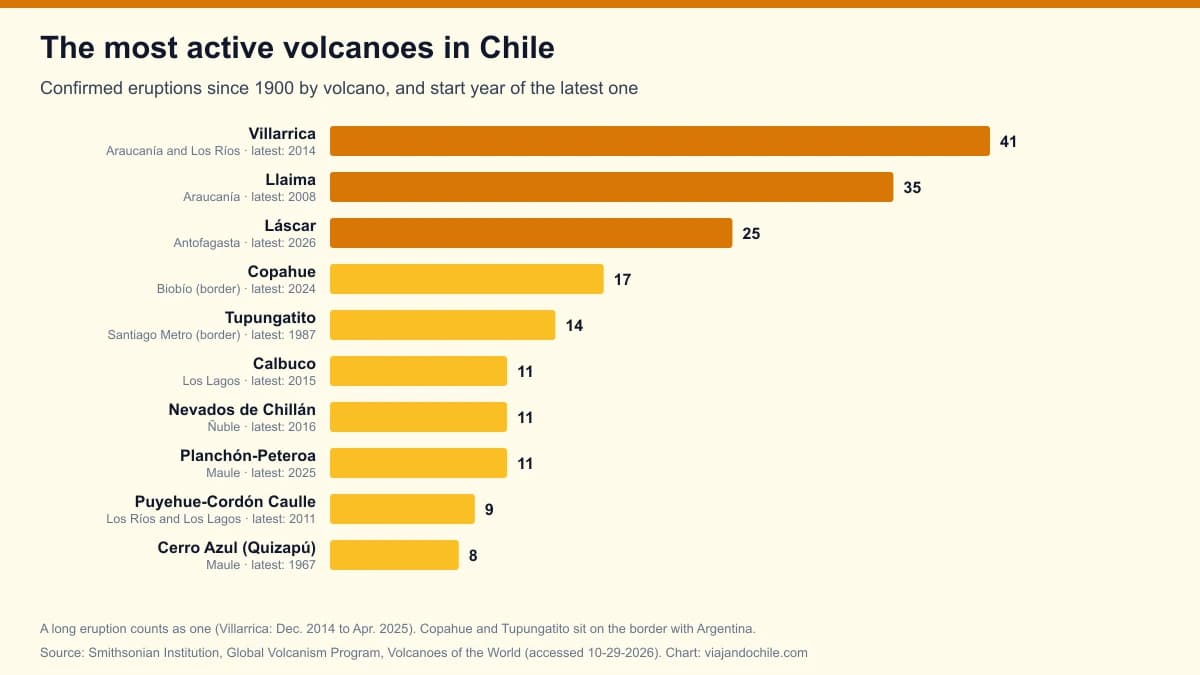
Villarrica is Chile's most active volcano: it has had 41 confirmed eruptions since 1900 and 152 across the Holocene (the last 11,700 years), followed by Llaima, with 35 since 1900, and Láscar, with 25. That is what the *Volcanoes of the World* database of the Smithsonian Institution's Global Volcanism Program shows, the international reference used by volcanologists and agencies worldwide.
*Updated October 29, 2026, with the Global Volcanism Program database as consulted that day.* The count includes only eruptions the program classifies as confirmed (583 from the 90 Chilean or border volcanoes active in the Holocene) and leaves out the 70 it marks as uncertain.
Ranking of the most active volcanoes in Chile since 1900
| Rank | Volcano | Region | Eruptions since 1900 | Holocene eruptions | Start of the latest |
|---|---|---|---|---|---|
| 1 | Villarrica | La Araucanía and Los Ríos | 41 | 152 | 2014 |
| 2 | Llaima | La Araucanía | 35 | 56 | 2008 |
| 3 | Láscar | Antofagasta | 25 | 33 | 2026 |
| 4 | Copahue | Biobío (on the border with Argentina) | 17 | 21 | 2024 |
| 5 | Tupungatito | Santiago Metropolitan (on the border with Argentina) | 14 | 18 | 1987 |
| 6 | Calbuco | Los Lagos | 11 | 36 | 2015 |
| 7 | Nevados de Chillán | Ñuble | 11 | 26 | 2016 |
| 8 | Planchón-Peteroa | Maule | 11 | 21 | 2025 |
| 9 | Puyehue-Cordón Caulle | Los Ríos and Los Lagos | 9 | 26 | 2011 |
| 10 | Cerro Azul (Quizapú) | Maule | 8 | 9 | 1967 |
| 11 | Lautaro | Magallanes | 7 | 9 | 1979 |
| 12 | Cerro Hudson | Aysén | 3 | 15 | 2011 |
Source: Smithsonian Institution, Global Volcanism Program, *Volcanoes of the World* (confirmed eruptions, consulted October 29, 2026). Ranked by eruptions since 1900; ties broken by Holocene eruptions. Compiled by Viajando Chile. The pages for Villarrica, Llaima and Láscar detail every eruption.
Among Chilean or border volcanoes, 27 have had at least one confirmed eruption since 1900, adding up to 216 eruptions in that period. Since 2000 there have been 39, at only 10 volcanoes: the one with the most this century is Copahue, with 10.
How the Smithsonian counts eruptions
The Global Volcanism Program records each eruption as an episode with a start and end date. A long eruption counts as one: Villarrica's latest, for example, began on December 2, 2014 and the database considers it ended on April 19, 2025, more than ten years later, and it counts the same as a one-day explosion. That is why the ranking measures how often a volcano wakes up, not how long it stays active.
To measure the size of each eruption, the database uses the Volcanic Explosivity Index (VEI), a 0-to-8 scale in which each step represents roughly ten times more erupted material. Most Chilean eruptions of the last century were VEI 1 to 3.
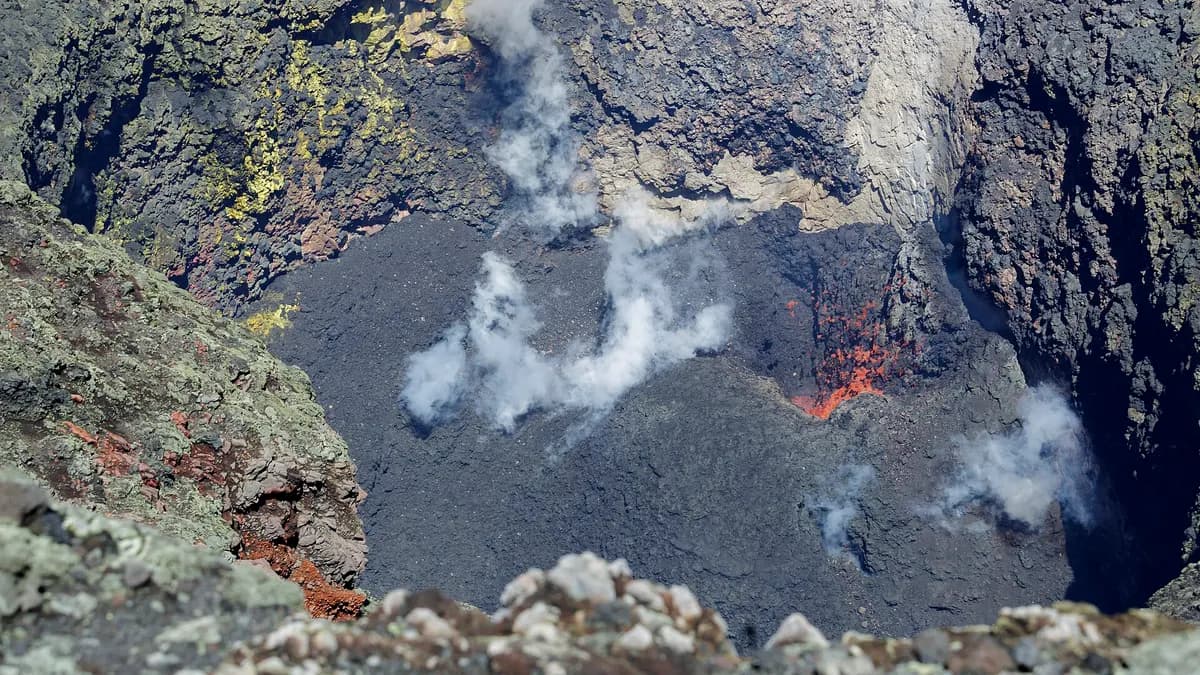
The most recent eruptions in Chile
| Volcano | Start | End | VEI |
|---|---|---|---|
| Láscar | February 8, 2026 | February 8, 2026 | Not assigned |
| Planchón-Peteroa | October 25, 2025 | December 4, 2025 | 2 |
| Copahue | October 16, 2024 | October 27, 2024 | 1 |
| Láscar | December 10, 2022 | February 3, 2023 | 3 |
| Nevados de Chillán | January 8, 2016 | October 17, 2022 | 2 |
| Calbuco | April 22, 2015 | May 26, 2015 | 4 |
| Villarrica | December 2, 2014 | April 19, 2025 | 3 |
| Puyehue-Cordón Caulle | June 4, 2011 | April 21, 2012 | 5 |
| Chaitén | May 2, 2008 | May 31, 2011 | 4 |
Source: Smithsonian Institution, Global Volcanism Program. Smaller intermediate eruptions of Copahue (2012 to 2021) and Planchón-Peteroa (2010 to 2019) are omitted. Láscar, in the Antofagasta region, is the latest Chilean volcano with a recorded eruption: on February 8, 2026.
Do you offer climbs, tours or lodging near a volcano? Reach travelers planning southern and northern Chile, in four languages.
See advertising optionsThe most explosive eruptions in Chile
Being very active does not mean a volcano has the biggest eruptions. Since 1800, the most explosive eruptions recorded in Chile did not come from Villarrica or Llaima:
| Volcano | Start year | VEI | Region |
|---|---|---|---|
| Puyehue-Cordón Caulle | 2011 | 5 | Los Ríos and Los Lagos |
| Cerro Hudson | 1991 | 5 | Aysén |
| Cerro Azul (Quizapú) | 1916 (climax in 1932) | 5 | Maule |
| Calbuco | 2015 | 4 | Los Lagos |
| Chaitén | 2008 | 4 | Los Lagos |
| Láscar | 1993 | 4 | Antofagasta |
| Carrán-Los Venados | 1955 | 4 | Los Ríos |
| Calbuco | 1893 | 4 | Los Lagos |
Source: Smithsonian Institution, Global Volcanism Program, confirmed eruptions of VEI 4 or higher since 1800. The database records Quizapú's activity as a single eruption between July 1916 and April 1932. Across the whole Holocene, the largest are two Cerro Hudson eruptions of VEI 6, dated to around 4750 and 1890 BC.
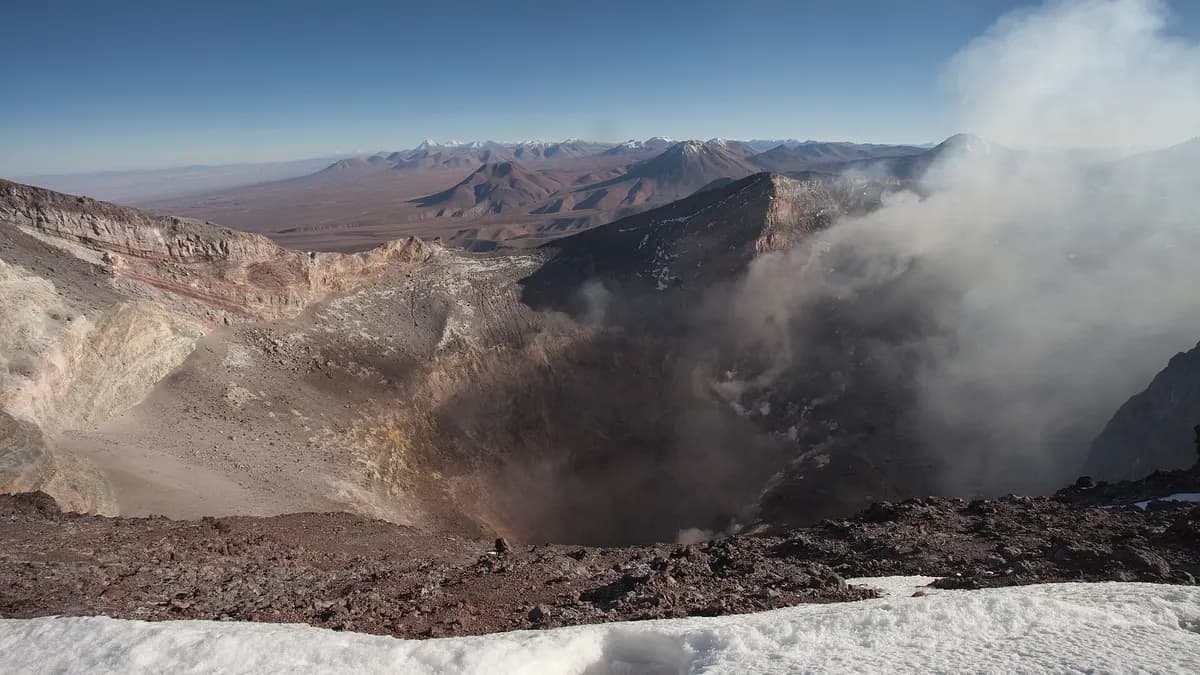
The most active volcanoes in Chile and their risk level
Activity is only part of the risk. The ranking prepared by the National Geology and Mining Service (Sernageomin) combines a volcano's hazard with the population, roads and infrastructure exposed to it, as we explained in Chile's most dangerous volcanoes. Comparing both lists:
| Volcano | Activity rank (since 1900) | Rank in Sernageomin's 2023 risk ranking |
|---|---|---|
| Villarrica | 1 | 1 |
| Llaima | 2 | 3 |
| Láscar | 3 | 14 |
| Calbuco | 6 | 2 |
| Nevados de Chillán | 7 | 10 |
| Puyehue-Cordón Caulle | 9 | 4 |
Sources: Global Volcanism Program (activity) and Sernageomin, 2023 Specific Risk Ranking of Active Volcanoes. Villarrica tops both lists: it is very active and has Pucón and Coñaripe at its foot. Láscar, third in activity, drops to 14th in risk because few people live around it.
What it means for visitors to Chile's volcanoes
- Check the technical alert before climbing: Sernageomin publishes each volcano's level (green, yellow, orange or red) and access to the crater is restricted depending on that level. The Villarrica climb, for example, depends on that alert, as we explained in how to climb Villarrica volcano.
- Very active is not the same as dangerous for tourists: Láscar is in the municipality of San Pedro de Atacama and its recent eruptions were small, but it is not a volcano to climb without a guide or permits.
- To see them up close safely, Villarrica and Conguillío (Llaima) national parks have trails with volcano views. If you are looking for the highest rather than the most active, see Chile's highest volcanoes and other natural records of Chile.
Frequently asked questions
What is the most active volcano in Chile?
Villarrica, with 41 confirmed eruptions since 1900 and 152 in the Holocene, according to the Smithsonian's Global Volcanism Program.
Which Chilean volcano erupted most recently?
Láscar, in the Antofagasta region, with an eruption recorded on February 8, 2026. Before that, Planchón-Peteroa, between October and December 2025.
How many active volcanoes does Chile have?
The Smithsonian database lists 90 Holocene volcanoes in Chile or on its borders with Argentina and Bolivia; 27 have had at least one confirmed eruption since 1900.
What was the largest eruption of the last century in Chile?
Three reached VEI 5: Quizapú (active between 1916 and 1932), Cerro Hudson in 1991 and Puyehue-Cordón Caulle in 2011.
How to cite this data
Viajando Chile (2026). *The most active volcanoes in Chile in 2026: Villarrica leads with 41 eruptions since 1900*. Based on data from the Smithsonian Institution's Global Volcanism Program. Available at: https://viajandochile.com/en/news/most-active-volcanoes-in-chile-ranking-eruptions