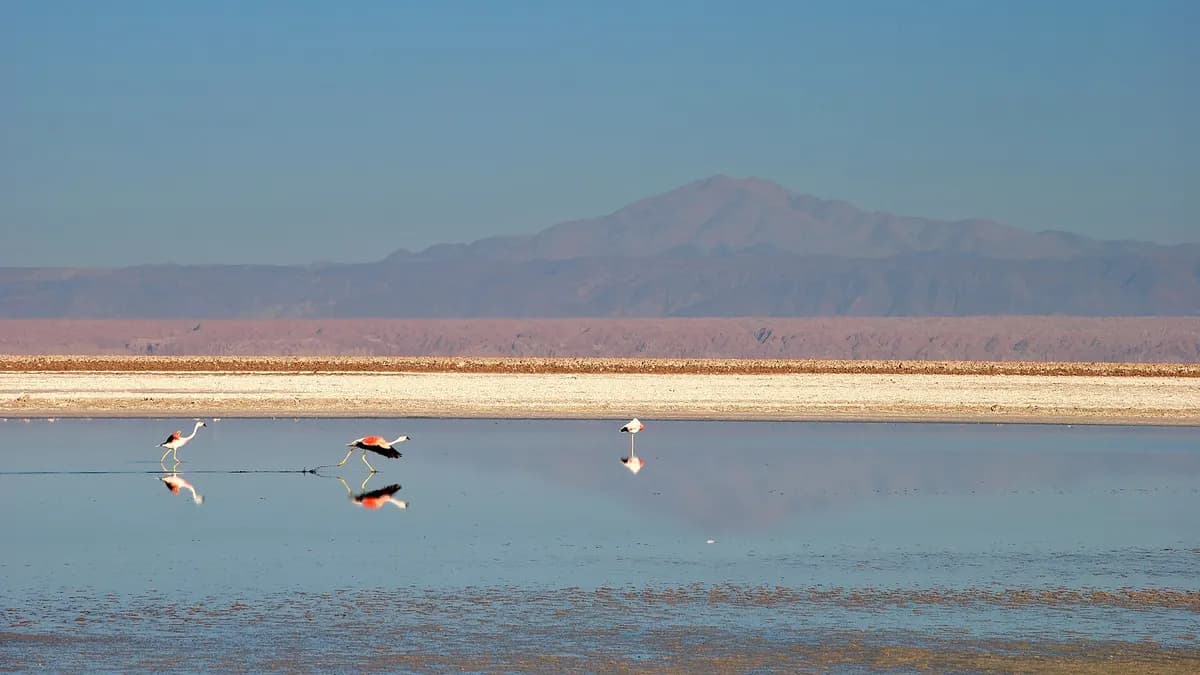
The Salar de Atacama is Chile's largest salt flat: about 3,000 km² of salt crust at roughly 2,300 meters, south of San Pedro de Atacama. The best place to see it is Chaxa lagoon, in the Soncor sector of Los Flamencos National Reserve, where three of the world's six flamingo species nest, according to Conaf. The lagoon is about 50 km from San Pedro, opens daily from 8:00 to 20:00 in spring and summer, and an adult foreigner's ticket costs CLP 13,714.
*Updated on November 3, 2026.* Hours and fees come from Conaf's page, Pases Parques and Ckapin Ticket, the ticketing system of the Toconao community, checked that day.
Salar de Atacama key facts
| Fact | Value | Source |
|---|---|---|
| Surface area | About 3,000 km²; Chile's largest salt flat | Copernicus (European Union programme), 2020 |
| Average elevation | About 2,300 m above sea level | European Space Agency (ESA), 2016 |
| Location | San Pedro de Atacama municipality, El Loa province, Antofagasta Region | Conaf |
| Protected area | Los Flamencos National Reserve: 73,986.5 ha in seven sectors; created on October 17, 1990 (Supreme Decree 50, Agriculture) | Conaf |
| Salt flat sectors in the reserve | Soncor (Chaxa lagoon) and Aguas de Quelana | Conaf |
| Lithium | The planet's largest lithium source, with about 30% of reserves (2016 figure) | ESA |
Sources: Copernicus, ESA and Conaf. The salt flat fills a closed basin between the Andes and the Domeyko range. Its surface is not a smooth white crust like Uyuni's: it is rough and grey, with shallow lagoons where flamingos feed. The reserve is co-managed by Conaf and communities of the Atacameño or Lickanantay people; Chaxa lagoon is run by the Toconao community.
Chaxa lagoon: tickets and hours in the Salar de Atacama
| Season | Hours | Last entry |
|---|---|---|
| Spring-summer (September to March) | 8:00 to 20:00 | 19:00 |
| Autumn-winter (April to August) | 7:00 to 19:00 | 18:00 |
Source: Conaf and Pases Parques, November 3, 2026. Hours may change due to weather, training or activities of the Toconao Atacameño Community. Tickets are sold on Ckapin Ticket and also cover Valle de Jere, a farming oasis next to Toconao:
| Chaxa lagoon + Valle de Jere ticket | Price |
|---|---|
| Foreign adult (18+) | CLP 13,714 |
| Foreign senior (60+), student, child (6 to 11) or teenager (12 to 17) | CLP 9,142 |
| Foreigner with disability | CLP 8,000 |
| Chilean adult | CLP 10,285 |
| Chilean teenager, senior, student or with disability | CLP 6,857 |
| Chilean of Indigenous descent (with certificate) | CLP 3,428 |
| Chilean children aged 0 to 11 | Free, no ticket |
Source: Ckapin Ticket, Chaxa lagoon + Valle de Jere, checked on November 3, 2026. Bring your ID or passport. Groups of more than 10 arrange their tickets via WhatsApp from the site's home page.
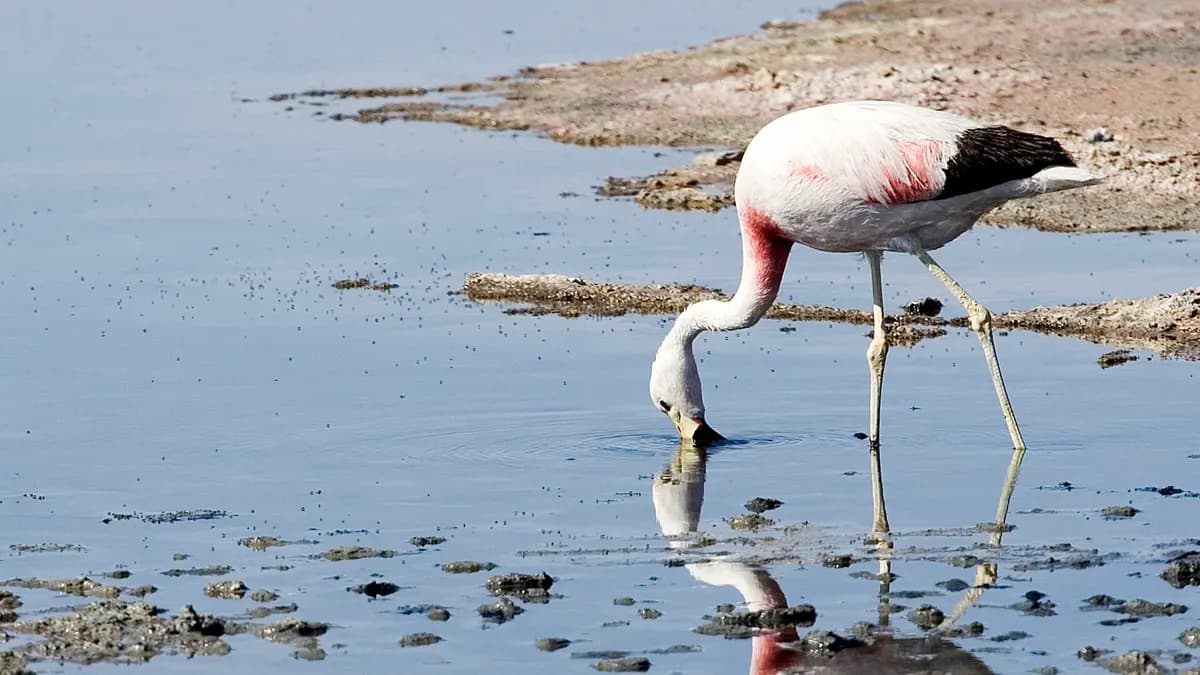
The flamingos of Chaxa lagoon
| Species | Scientific name | How to recognize it |
|---|---|---|
| Andean flamingo | Phoenicoparrus andinus | The largest; yellow legs and black-and-yellow bill |
| James's flamingo | Phoenicoparrus jamesi | The smallest; reddish legs |
| Chilean flamingo | Phoenicopterus chilensis | Greyish legs with red knees; pale pink plumage |
Source: species according to Conaf; the identification tips are a general birdwatching guide. The Toconao community adds that Chaxa is home to the Andean avocet, the Andean gull, the puna plover and an endemic lizard. Flamingos feed by filtering the lagoon water; do not approach them or leave the trails, as they are sensitive birds and the reserve is their nesting site.
How to get to Chaxa lagoon from San Pedro de Atacama
The lagoon is about 50 km from San Pedro, according to Meteored. Conaf gives access via route B-355, the San Pedro–Peine road, through Toconao. You can go on your own by car or on a tour.
| Option | How it works | Tip |
|---|---|---|
| Own car | San Pedro – Toconao – turn-off to Chaxa on route B-355 | Fine for a regular car; carry water and fuel |
| Afternoon tour | San Pedro agencies sell Chaxa at sunset, sometimes with Toconao | Ask whether the ticket is included |
| Full-day tour | Combined with the altiplano lagoons and Piedras Rojas | Early start; includes areas above 4,000 m |
The full-day tour usually combines Chaxa with the Miscanti and Miñiques lagoons and Piedras Rojas. Another salt flat classic is floating in Laguna Cejar, to the north and closer to San Pedro. Save the next afternoon for the Valle de la Luna, another sector of the same reserve.
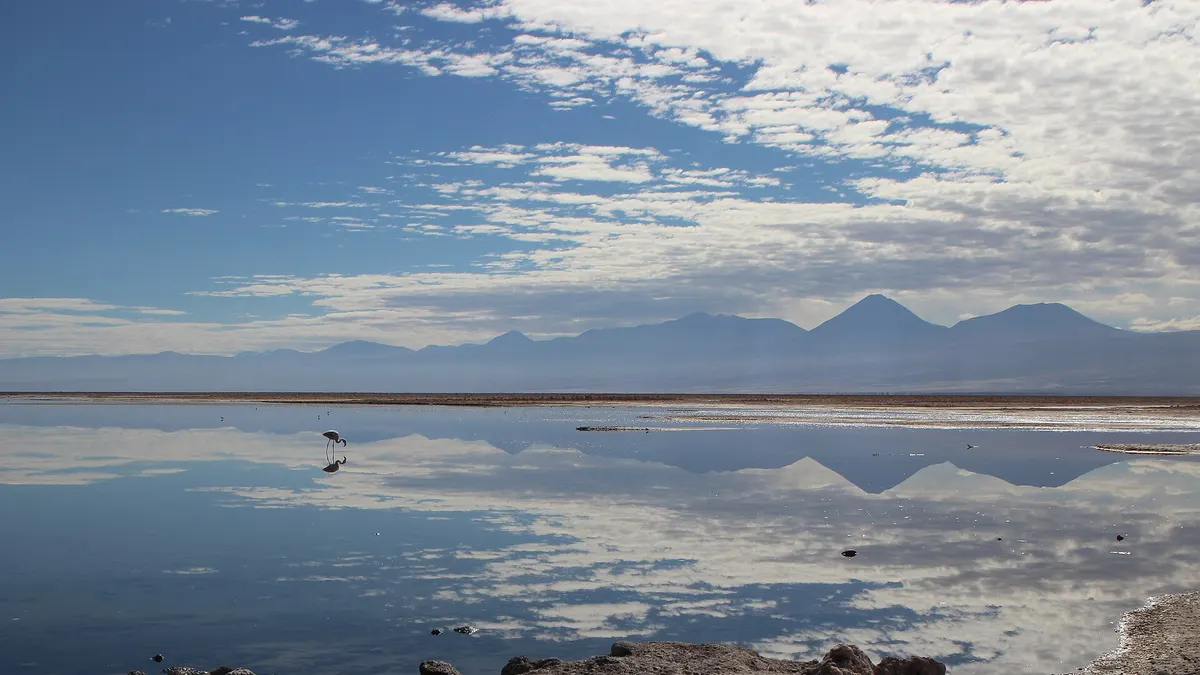
Best time and tips for visiting the Salar de Atacama
- Late-afternoon light, before closing, is the most sought-after for photographing reflections and flamingos; mornings are usually less windy.
- At 2,300 m the sun is strong and the air dry: wear sunscreen, a hat and sunglasses, and carry water.
- Temperatures drop and wind picks up in the afternoon: bring a jacket.
- There is nowhere to stay overnight in the reserve; visits are daytime only.
- No fires, smoking, pets or drones without authorization (Law 20,653).
- Visit only open sectors: Conaf warns that some traditional community sites are closed to tourism.
To plan the rest of your trip, see what to do in the Atacama Desert. Reserve administration in the Soncor ayllu: +56 9 8248 5000; Conaf Antofagasta: antofagasta.oirs@conaf.cl.
Frequently asked questions
How much does Chaxa lagoon cost?
CLP 13,714 for a foreign adult and CLP 10,285 for a Chilean adult, on a ticket that includes Valle de Jere, according to Ckapin Ticket as of November 3, 2026.
How big is the Salar de Atacama?
About 3,000 km², according to Copernicus. It is Chile's largest salt flat.
Are there always flamingos at Chaxa lagoon?
It is their habitat and nesting site, so flamingos are usually there, although numbers vary. Seeing all three species together takes some luck.
Can I go without a tour?
Yes, by car via the road to Toconao and route B-355. Buy your ticket on Ckapin Ticket and bring your ID.