Tourism contributed CLP 9.511 trillion (9,511 billion pesos) to Chile's economy in 2025, 2.8% of GDP, and it can now be measured region by region. The Undersecretariat of Tourism presented regional tourism GDP, a measurement that looks at two things: how much of national tourism GDP each region generates (share) and how much tourism weighs within that region's economy (intensity). The Santiago Metropolitan Region leads the first, with 38.5%; Magallanes leads the second, where tourism equals 7.3% of regional GDP.
| Indicator | Value | Source |
|---|---|---|
| Chile's tourism GDP, 2025 | CLP 9.511 trillion | Undersecretariat of Tourism |
| Share of national GDP | 2.8% | Undersecretariat of Tourism |
| Region with the largest share | Metropolitan (38.5%) | Undersecretariat of Tourism |
| Region with the highest intensity | Magallanes (7.3% of regional GDP) | Undersecretariat of Tourism |
| Region whose tourism GDP grew most, 2018-2025 | Antofagasta (+82%) | Diario Financiero |
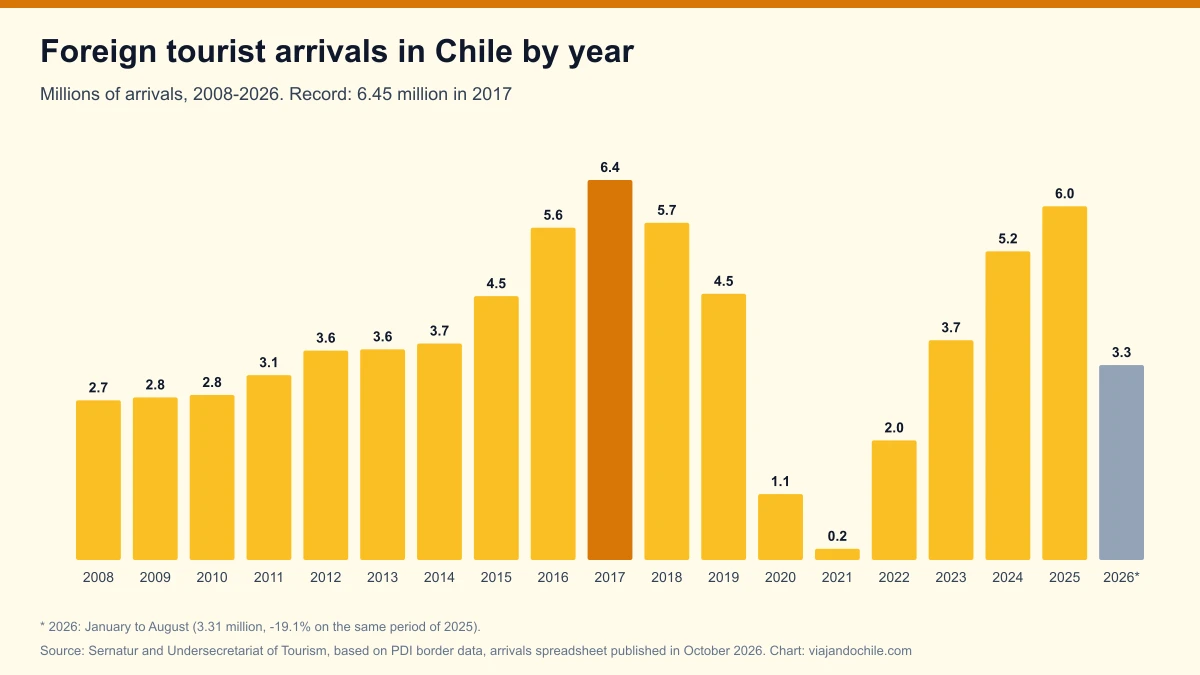
| Foreign tourists in 2025 | 6,004,567 | Sernatur with PDI data |
The indicator counts the value generated by activities that directly serve tourists and day-trippers: accommodation, restaurants, passenger transport, retail, travel agencies, vehicle rental, and arts, entertainment and recreation.
Regional tourism GDP: where it is generated
| Region | Share of national tourism GDP | Change 2018-2025 (points) |
|---|---|---|
| Metropolitan | 38.5% | -2.08 |
| Valparaíso | 12.25% | +0.60 |
| Antofagasta | 6.10% | +0.72 |
| Biobío | 5.71% | — |
| Los Lagos | 5.59% | — |
| La Araucanía | 5.18% | — |
Sources: Undersecretariat of Tourism (October 7, 2026) and Diario Financiero for the 2018-2025 changes. The published sources do not give the figure for all 16 regions; the table shows those that were reported.
According to Diario Financiero, Antofagasta is the region whose tourism GDP grew most (82%) over the period, and Coquimbo (+0.34 points) and O'Higgins (+0.25) also gained weight. Arica y Parinacota lost 0.40 points: its tourism GDP grew 22%, while its overall economy grew 88%.
Intensity: where tourism weighs most in the regional economy
| Region | Tourism as % of regional GDP |
|---|---|
| Magallanes and Chilean Antarctica | 7.3% |
| La Araucanía | 5.4% |
| Los Ríos | 4.9% |
| Valparaíso | 4.7% |
| Aysén | 4.5% |
| Metropolitan | 2.9% |
| Antofagasta | 1.5% |
| National average | 2.8% |
Sources: Undersecretariat of Tourism and Diario Financiero (Metropolitan and Antofagasta). 2025 data.
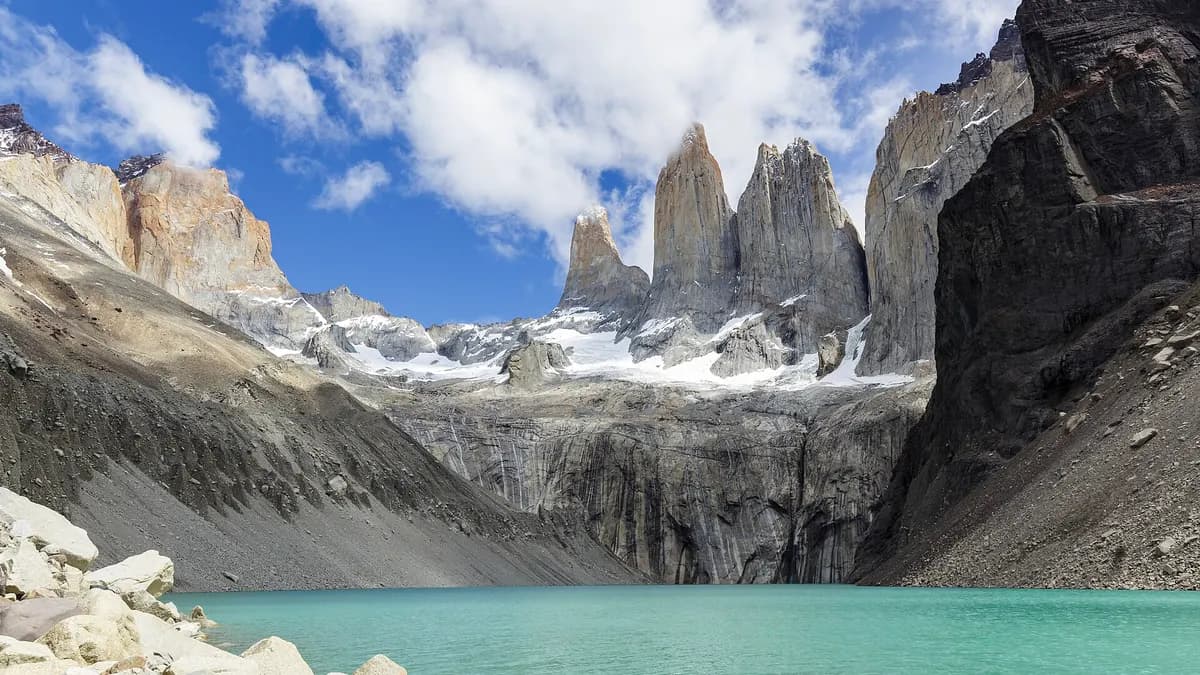
The difference between the two tables is the key to the measurement. Santiago concentrates the largest volume because most of the economy, the main airport and the business hotels are there, but tourism is only 2.9% of its GDP. In Magallanes, by contrast, Torres del Paine, Puerto Natales and the cruises of the Strait make tourism more than two and a half times as important as the national average. The same goes for La Araucanía and Los Ríos, with Pucón, the lakes and the volcanoes.
“The importance of tourism is very different between regions, and two measures are needed to see it,” explained Under-Secretary of Tourism María Paz Lagos. The minister of Economy and Mining, Daniel Mas, said the indicator “is one more step that consolidates the tourism industry”.

What regional tourism GDP says about travelling in Chile
- The south and Patagonia live off visitors: in Magallanes, La Araucanía, Los Ríos and Aysén tourism is between 4.5% and 7.3% of the economy. To explore them, see what to do in Puerto Natales, what to do in Pucón and what to do in Coyhaique.
- Antofagasta is growing: it is the region where tourism GDP rose most since 2018, and it is home to San Pedro de Atacama; our San Pedro de Atacama guide will help you plan.
- Santiago loses relative weight: the capital is still the largest, but tourism is more spread across the regions than in 2018.
The context: a year with fewer foreign tourists
The measurement comes in a 2026 with fewer international arrivals: between January and August 3,308,873 foreign tourists entered Chile, 19.1% fewer than in the same period of 2025, because of the drop in the Argentine market, as we reported in tourist arrivals in August 2026. At the same time, the 2027 Budget does not increase funding for international promotion, as we explained in our story on the tourism budget.
Does your regional tourism business want to reach travellers planning their next destination in Chile?
See advertising optionsFrequently asked questions
How much does tourism contribute to Chile's GDP?
CLP 9.511 trillion in 2025, equal to 2.8% of GDP, according to the Undersecretariat of Tourism.
In which region does tourism weigh most?
In Magallanes and Chilean Antarctica, where it equals 7.3% of regional GDP. It is followed by La Araucanía (5.4%) and Los Ríos (4.9%).
Which region generates the most tourism GDP?
The Santiago Metropolitan Region, with 38.5% of the national total, followed by Valparaíso (12.25%) and Antofagasta (6.10%).