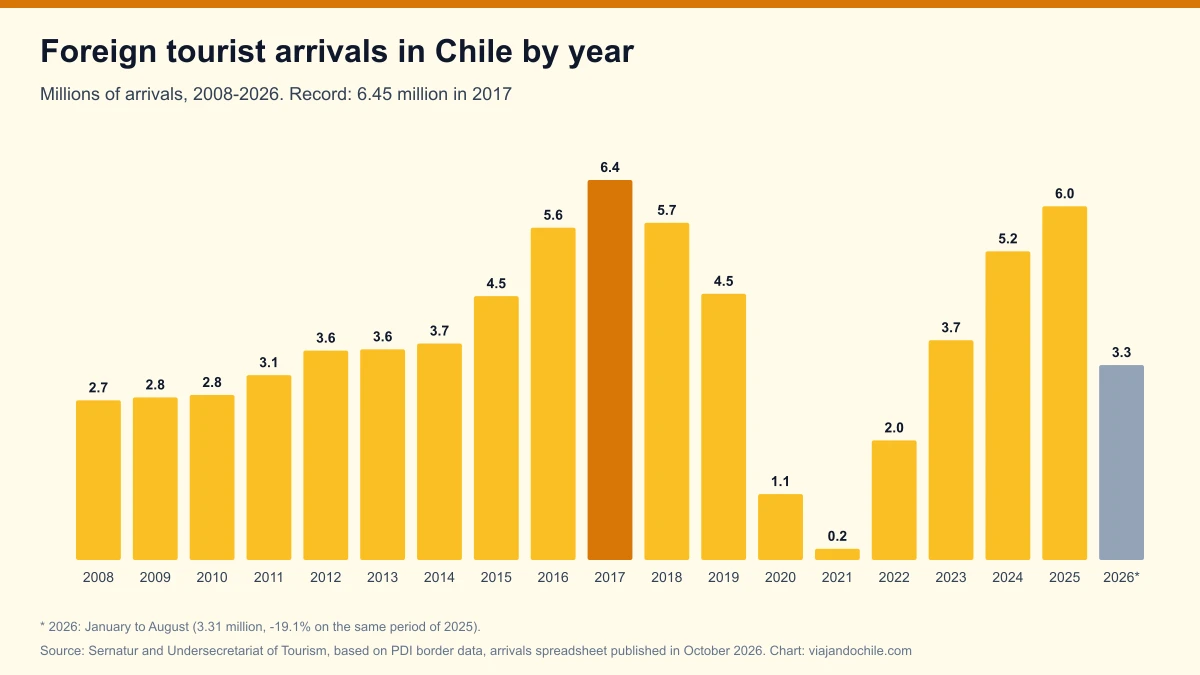
Foreign tourism in Chile is having a two-sided 2026. Total arrivals fell sharply because of the collapse in Argentine visitors, but travelers from Europe, North America, Asia and Oceania have never been so numerous. Chile received 2,553,723 foreign tourists in the first half of the year, 19.4% fewer than in the same period of 2025, according to the Pulso Turismo report from the Undersecretariat of Tourism.
In the same six months, 529,018 long-haul tourists arrived, 13.9% more than a year earlier. It is the highest figure in the series available since 2013 and beats the 519,905 of the first half of 2019, the last before the pandemic.
Foreign tourists in Chile: first-half and second-quarter figures
| Indicator | Figure | Year-on-year change | Source |
|---|---|---|---|
| Foreign tourists, January-June 2026 | 2,553,723 | −19.4% | Undersecretariat of Tourism |
| Long-haul tourists, January-June 2026 | 529,018 | +13.9% (record since 2013) | Undersecretariat of Tourism |
| Foreign tourists, April-June 2026 | 843,659 | −22.8% | INATUR, via Radio Agricultura |
| Argentine tourists, April-June 2026 | 316,326 | −43.2% | INATUR, via Radio Agricultura |
| Estimated inbound tourism revenue, January-June | — | approx. −7.7% | Undersecretariat of Tourism |
The figures are provisional and may be revised in future reports. Tourism revenue fell much less than arrivals, around 7.7%, because the visitors who are growing the most are also the ones who spend the most.
Why Argentine visitors are falling
Argentina is still Chile's main market, but between April and June 316,326 Argentines arrived, 43.2% fewer than a year earlier, according to the INATUR tourism activity index reported by Radio Agricultura. Argentina alone took 11.29 points off the inbound tourism sub-index, which fell 9.11% in the quarter.
The previous year had been exceptional: in 2025 Chile received 6,004,567 foreign tourists, 14.6% more than in 2024, driven by Argentines shopping on the Chilean side of the Andes. That wave of visitors eased in 2026, and it is the main reason for the decline.
The fastest-growing markets
Outside Argentina, the picture is positive. Between January and July, markets other than Argentina grew 4% to 1.8 million visitors. In the second quarter, nine of the fifteen markets measured by INATUR increased their arrivals.
| Country | Growth in arrivals, January-June 2026 |
|---|---|
| Australia | +80.1% |
| Poland | +32.1% |
| China | +28% |
| United States | +11.5% |
| Canada | +10.8% |
| England | +10.6% |
Undersecretary of Tourism María Paz Lagos summed up the goal: "We want to attract more tourists, who stay longer, spend on more experiences and travel to more regions." On the second quarter, she said that "nine of the fifteen international markets we measure increased their arrivals."
Does your hotel, agency or transport company want to reach long-haul travelers planning their trip to Chile?
See advertising formatsHow much each foreign tourist spends in Chile
The difference in spending explains why revenue fell less than arrivals. The Undersecretariat estimated how much a tourist spends per trip by origin, and noted that it is an analytical estimate, not an official statistic.
| Tourist's origin | Estimated spending per trip |
|---|---|
| United States | US$1,385 |
| Europe | US$1,278 |
| Argentina | US$299 |
An American tourist spends on average more than four times as much as an Argentine one. Argentines tend to make short overland trips, often for shopping, while Europeans and North Americans arrive by plane and stay longer, visiting destinations such as Patagonia, Atacama or Easter Island. Our guide to how much it costs to travel to Chile helps put those budgets in perspective.

Domestic tourism keeps activity going
While inbound tourism fell, Chileans traveled more within their own country. Overnight trips by residents grew 1.53% in the second quarter and contributed 1.20 points to INATUR, which stood at 87.4 points, just 0.74% below the same quarter of 2025. Short trips rose 3.9% and long trips fell 0.8%.
What it means for travelers to Chile
- Less crowding on the Argentine border: with fewer Argentine visitors, mountain passes and shopping destinations are under less pressure than in 2025.
- More demand in Patagonia and the north: long-haul markets concentrate on nature destinations; it pays to book early for the summer season, as we explain in when to visit Chile.
- More direct flights: several airlines added routes for summer 2026-2027, expanding the offer from North America.
Where long-haul tourists go
Travelers from Europe, North America, Asia and Oceania usually visit more regions than visitors from neighboring countries. The most common itineraries combine Santiago with Chilean Patagonia, the Atacama Desert and Easter Island, destinations that require domestic flights and stays of several days. That is the underlying reason for their higher spending: they pay for more nights, more tours and more flights.
For tour operators, the change in the visitor mix also changes the calendar. Argentines travel a lot in summer and on long weekends, and concentrate in central Chile and in cities near the border. Long-haul tourists, by contrast, spread out between spring and autumn, and fill the national parks of the south between November and March.
What we still don't know
Second-half figures have not been published yet. The next report will show whether the drop in Argentine visitors eased over the winter and whether the long-haul record holds through the summer season and the new air routes from North America.
Does your tourism brand want to appear in front of travelers comparing destinations in Chile?
See advertising formatsFrequently asked questions
How many foreign tourists visited Chile in 2026?
Between January and June 2026, 2,553,723 foreign tourists arrived, 19.4% fewer than in the same period of 2025, according to the Undersecretariat of Tourism. The figures are provisional.
Why did foreign tourism in Chile fall?
Mainly because of the drop in Argentine tourists, who fell 43.2% in the second quarter. Excluding Argentina, arrivals grew 4% between January and July.
Which countries send the most long-haul tourists?
Europe, North America, Asia and Oceania. The fastest-growing in the first half were Australia (80.1%), Poland (32.1%) and China (28%).